


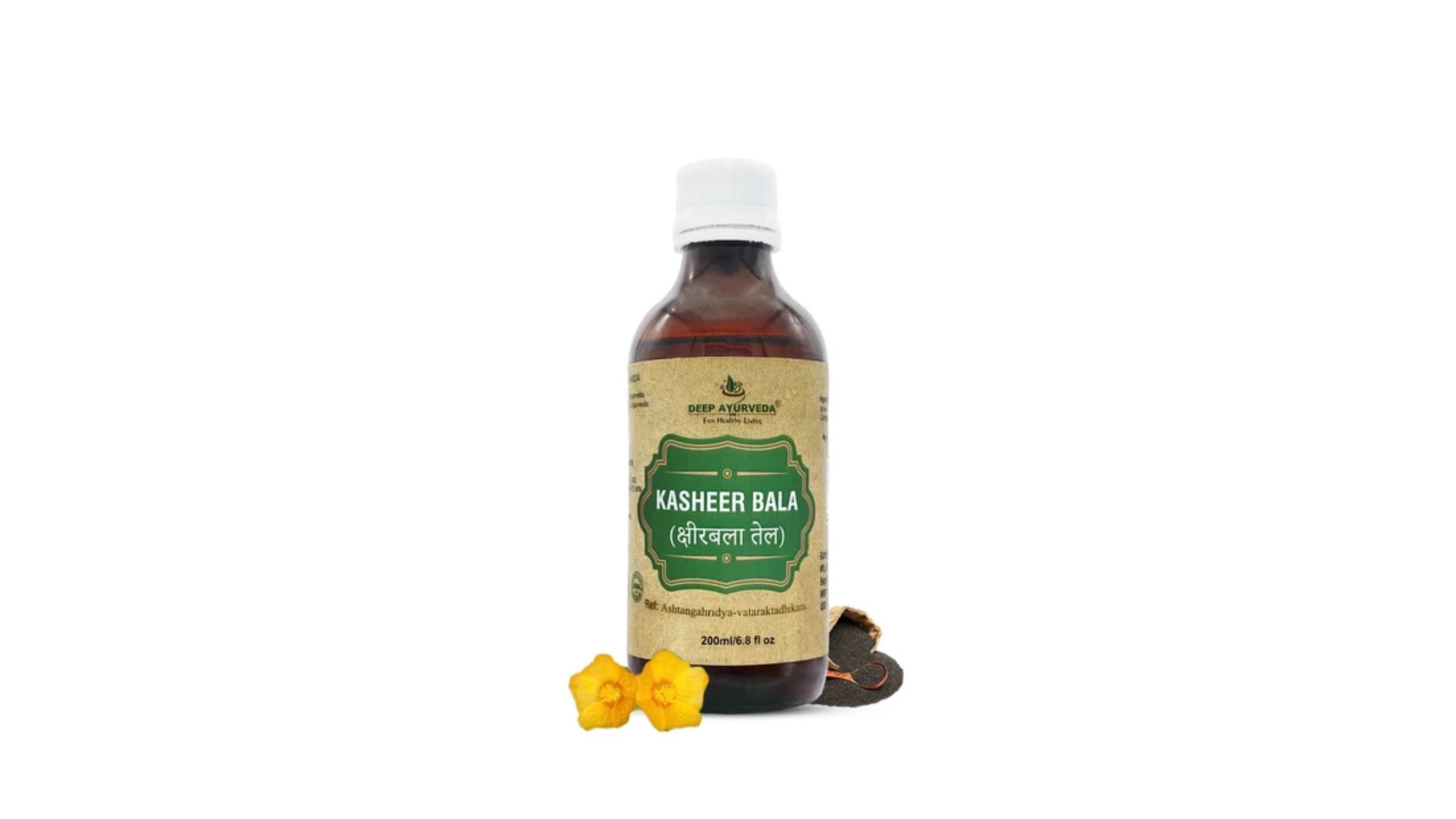
Ksheerabala Oil, traditionally known as Ksheerabala Taila, is a classical Ayurvedic medicated oil prepared primarily using Bala, milk and sesame oil. In Ayurveda, it is traditionally associated with Vata-oriented care and is used in practices such as Abhyanga and other therapeutic oil applications. Its preparation method, formulation, route of use and intended purpose can vary, so traditional Ayurvedic applications should be distinguished from modern clinical evidence.
Unlike ordinary massage oils, Ksheerabala Oil is a medicated Sneha formulation in which herbal ingredients are processed with an oil base and liquid media. This preparation process is an important part of understanding what Ksheerabala Taila actually is.
In this guide, we will explore its ingredients, Ayurvedic background, traditional uses, preparation, benefits, Ksheerabala 101, how to apply it, precautions and what modern research has—and has not—established.
What Is Ksheerabala Oil?
Ksheerabala Oil is an Ayurvedic medicated oil traditionally prepared with Bala (Sida cordifolia), Ksheera (milk) and Tila Taila (sesame oil).
The word Ksheerabala can be understood through its components:
- Ksheera = milk
- Bala = the Ayurvedic herb Bala
- Taila = oil
The formulation is therefore not simply a mixture of an herb and sesame oil. Traditional preparation involves processing the herbal material with the oil and liquid components through the Ayurvedic Sneha Paka process.
Pharmacopoeial descriptions of Ksheerabala Taila include Bala decoction, Bala paste, sesame oil, cow’s milk and water as formulation components.
Is Ksheerabala Oil the same as Ksheerabala Taila?
In common usage, Ksheerabala Oil, Ksheerabala Taila and Ksheerabala Thailam generally refer to the same Ayurvedic formulation or closely related preparations.
The spelling may differ depending on transliteration and regional usage:
- Ksheerabala Taila
- Ksheerabala Thailam
- Kshirabala Taila
- Kshirabala Oil
However, consumers should still check the actual ingredient list because commercially available products can differ in formulation, processing method and intended use.
Classical Ayurvedic Background of Ksheerabala Taila
Ksheerabala Taila belongs to the broader Ayurvedic tradition of Sneha Kalpana, the preparation of medicated oils and ghee in which herbal ingredients are processed with a lipid medium.
Classical Ayurvedic literature describes several Bala-based medicated oil preparations, and published Ayurvedic research has discussed Ksheerabala Taila in connection with these traditional formulations. One published study describes Ksheerabala Taila using Ksheera (cow’s milk), Bala and Tila Taila as its principal ingredients.
From an Ayurvedic perspective, the formulation is particularly associated with approaches used for Vata-oriented conditions and therapies.
However, an important distinction should be made: an Ayurvedic description such as Vata does not correspond one-to-one with a modern medical diagnosis. Therefore, traditional Ayurvedic indications should not automatically be interpreted as proof that the oil treats a specific modern disease.
What Are the Ingredients in Ksheerabala Oil?
The identity of the ingredients is one of the most important things to understand before discussing the benefits of Ksheerabala Oil.
| Ingredient | Ayurvedic name | Common identity | Role in the formulation |
|---|---|---|---|
| Bala | Bala | Sida cordifolia | Principal herbal ingredient |
| Milk | Ksheera | Cow’s milk | Liquid processing component |
| Sesame oil | Tila Taila | Sesamum indicum | Oil base |
| Water | Jala | Water | Used during preparation |
Pharmacopoeial information describes Bala decoction, Bala paste, sesame oil, cow’s milk and water in specified proportions for the preparation.
1. Bala (Sida cordifolia)
Bala is one of the central ingredients of Ksheerabala Taila.
In the Ayurvedic materia medica, Bala is traditionally associated with properties described using concepts such as Balya and Brimhana, and it has an important place in formulations intended for Vata-oriented care.
Modern botanical identification is also important. Published research has highlighted challenges associated with authenticating Sida species, which makes proper botanical identification relevant when discussing the quality of Bala-containing formulations.
2. Ksheera (Milk)
Milk is not merely an additional ingredient added for marketing purposes. In the classical preparation, it forms part of the liquid medium used during processing.
From the Ayurvedic perspective, Ksheera is traditionally considered nourishing and unctuous and is used in formulations where these qualities are desired.
3. Tila Taila (Sesame Oil)
Sesame oil provides the primary lipid base of the formulation.
In Ayurveda, Tila Taila is traditionally associated with Vata management and is widely used as a base for medicated oils.
This is one reason why Ksheerabala Taila should not be considered equivalent to ordinary sesame oil: the herbal and milk components undergo a specific processing procedure with the oil.
How Is Ksheerabala Oil Prepared?
This is one of the areas where Ksheerabala Taila differs substantially from an ordinary herbal oil.
Traditional preparation involves the principles of Sneha Paka, in which the herbal ingredients and liquid media are processed with the oil under controlled conditions.
A pharmacopoeial description lists Bala Kashaya, Bala Kalka, sesame oil, cow’s milk and water among the ingredients used in Ksheerabala Taila.
The broad process can be understood as follows:
Step 1: Preparation of Bala
The required Bala material is prepared according to the formulation specifications.
Step 2: Preparation of Bala Kashaya
Bala is processed to prepare its decoction, known as Bala Kashaya.
Step 3: Preparation of Bala Kalka
A finer paste of the herbal material, known as Kalka, forms another component of the Sneha preparation.
Step 4: Combining the ingredients
The herbal decoction and paste are combined with sesame oil and milk according to the formulation procedure.
Step 5: Sneha Paka
The mixture is processed carefully so that the desired transformation of the liquid and herbal components into the oil medium takes place.
Step 6: Completion and filtration
Once the preparation reaches the required stage, the medicated oil is filtered and stored appropriately.
Why does the preparation method matter?
Because the process is part of the formulation.
Ksheerabala Taila is not simply sesame oil + Bala + milk. The way those ingredients are processed together affects the finished preparation.
Historical standardisation research on Ksheerabala Taila specifically examined different stages of medicated-oil preparation, highlighting the Ayurvedic importance of identifying the appropriate Paka stage.
What Is Ksheerabala 101?
If you search for Ksheerabala Oil in India, you will frequently encounter the term Ksheerabala 101.
The 101 refers to a form of repeated processing known as Avartana in Ayurvedic pharmaceutical practice.
In simple terms, Avartana refers to repeating the process of preparing or processing a formulation.
Is Ksheerabala 101 simply 101 times stronger?
It is better not to interpret the number that way.
Ksheerabala 101 indicates a particular repeated-processing tradition; it should not automatically be interpreted as a scientifically established statement that the product is 101 times more powerful.
The actual quality and characteristics of a product depend on factors such as:
- the identity and quality of raw materials
- the formulation followed
- the processing method
- the number and manner of processing cycles
- manufacturing controls
- storage conditions
Published Ayurvedic literature has examined Ksheerabala preparations and their standardisation, while clinical literature has also documented the use of Ksheerabala 101 in specific Ayurvedic treatment protocols.
Traditional Uses of Ksheerabala Oil in Ayurveda
Ksheerabala Taila has a long-standing place in Ayurvedic therapeutic practice.
Its traditional use is best understood through Ayurvedic procedures and principles, rather than through a long list of modern diseases.
Abhyanga
Abhyanga is the Ayurvedic practice of applying and massaging oil over the body.
Ksheerabala Taila may be selected in certain Ayurvedic contexts where its traditional properties are considered appropriate.
Local Oil Application
An Ayurvedic practitioner may recommend medicated oil for local application depending on the individual’s condition, constitution and treatment plan.
Head and Scalp Application
Certain Ayurvedic practices involve applying medicated oils to the head or scalp. The appropriate oil and method depend on the therapeutic objective.
Padabhyanga
Padabhyanga refers to Ayurvedic foot massage with oil.
Ksheerabala Taila may be used in certain traditional contexts, although the choice of oil should ideally be based on the individual’s needs rather than assuming that one oil is suitable for everyone.
Professional Ayurvedic Procedures
Ksheerabala Taila has also been studied or used as part of specific Ayurvedic therapeutic procedures, including procedures that should be performed under professional supervision.
For example, clinical literature has investigated Ksheerabala Taila as part of Ayurvedic interventions such as Basti and Kati Basti.
Ksheerabala Oil Benefits: What Does Ayurveda Say?
The word benefits needs some context when discussing an Ayurvedic medicine.
Some benefits attributed to Ksheerabala Oil online are traditional Ayurvedic claims, while others are presented as if they were clinically proven medical effects. These should not be treated as the same thing.
Traditional Ayurvedic benefits and applications include:
1. Support for Vata-oriented care
Ksheerabala Taila is traditionally associated with Vata management because of the qualities attributed to its ingredients and oil base.
2. Traditionally used for oil massage
Its unctuous nature makes it suitable for selected Ayurvedic oil-application practices.
3. Traditionally associated with nourishment
Bala and the other components are traditionally understood in Ayurveda in the context of nourishing and strengthening approaches.
4. Traditionally used for stiffness and musculoskeletal discomfort
Ayurvedic practitioners may use medicated oils in massage-based approaches where stiffness, dryness or discomfort are present.
5. Traditionally used in selected neurological and Vata-related conditions
Classical Ayurvedic practice includes Ksheerabala-based preparations in certain Vata-oriented therapeutic contexts.
However, this should not be interpreted as proof that applying Ksheerabala Oil independently cures neurological diseases.
What Does Modern Research Say About Ksheerabala Oil?
This is where it is important to separate traditional use from clinical evidence.
Modern research on Ksheerabala Taila exists, but much of it investigates the oil as part of a broader Ayurvedic treatment protocol, rather than testing a standard topical Ksheerabala Oil product as an isolated intervention.
For example, a published study examined Ksheerabala Taila Anuvasana Basti in the Ayurvedic management of Sandhigata Vata, which was correlated with osteoarthritis in that study.
Another randomized study investigated Kati Basti using Ksheerabala Taila as part of an Ayurvedic approach for chronic low back pain.
There are also research protocols involving Ksheerabala Taila in other Ayurvedic therapeutic contexts.
What does this evidence actually tell us?
It tells us that Ksheerabala Taila has been investigated within clinical Ayurvedic settings.
It does not establish that:
- the oil cures every condition mentioned online
- topical application alone produces the outcomes seen in a multi-component Ayurvedic treatment
- every commercially available Ksheerabala Oil is identical to the preparation used in a study
- traditional Ayurvedic concepts can be directly converted into modern medical diagnoses
This distinction makes health information more accurate and helps readers understand what research can—and cannot—tell them.
How to Apply Ksheerabala Oil
For ordinary external application, the exact method can depend on why the oil is being used.
A general application approach is:
Step 1: Check the product label
Before use, confirm that the particular product is intended for external application and follow the manufacturer’s instructions.
Step 2: Warm the oil gently if appropriate
Many people prefer medicated oils at a comfortably warm temperature for massage.
Avoid overheating the oil.
Step 3: Start with a small amount
Apply enough oil to cover the intended area without unnecessarily soaking the skin.
Step 4: Massage gently
Use comfortable, controlled movements.
There is no need to apply excessive pressure simply because an area feels stiff or uncomfortable.
Step 5: Allow appropriate contact time
The required duration can vary according to the purpose of application and practitioner instructions.
Step 6: Clean the skin afterward if required
A warm bath or shower may be used after massage according to personal preference and the specific Ayurvedic routine being followed.
How to Use Ksheerabala Oil for Abhyanga
Abhyanga is more than simply rubbing oil onto the skin.
Traditional Ayurvedic massage involves the purposeful application of oil over the body.
A simple external-use routine may involve:
- Choosing a comfortable environment.
- Warming the oil gently.
- Applying oil gradually rather than pouring large quantities at once.
- Using gentle, rhythmic massage movements.
- Paying attention to areas that commonly become dry or tense.
- Avoiding aggressive pressure over injured or acutely inflamed areas.
- Bathing afterward if appropriate.
For therapeutic Abhyanga, particularly when it is being used as part of treatment for a medical condition, it is preferable to follow an Ayurvedic practitioner’s instructions.
Can Ksheerabala Oil Be Used on the Head and Scalp?
Ksheerabala Taila is used in some Ayurvedic contexts for head-related oil applications.
However, can be applied to the scalp and will treat a scalp or neurological condition are very different statements.
If using it on the scalp:
- check that the product is intended for that route
- avoid application to broken or infected skin
- stop if significant irritation occurs
- keep the oil away from the eyes
- wash the scalp if irritation or discomfort develops
Claims such as guaranteed hair regrowth or treatment of neurological disorders should not be inferred simply because an oil is traditionally used on the head.
Can Ksheerabala Oil Be Used Every Day?
There is no single daily-use schedule that is appropriate for everyone.
Frequency can depend on:
- the reason for using the oil
- the particular formulation
- skin tolerance
- age
- season
- Ayurvedic treatment plan
- whether the oil is being used for routine massage or therapeutic care
For general self-care, follow the product directions.
For therapeutic use, especially in a diagnosed condition, follow the advice of a qualified healthcare or Ayurvedic professional.
Ksheerabala Oil Safety and Precautions
Although Ksheerabala Oil is traditionally used externally, natural does not automatically mean risk-free.
Skin sensitivity
People with sensitive skin may experience irritation from herbal or oil-based products.
A small patch test can be considered before extensive application.
Damaged or infected skin
Avoid applying oil over open wounds, active skin infections or significantly damaged skin unless specifically advised by a healthcare professional.
Allergies
If you have a known allergy to sesame, milk-derived ingredients or any component of the formulation, check the product label carefully before use.
Children
Do not assume that a formulation intended for adults is automatically appropriate for young children.
Pregnancy and breastfeeding
Pregnancy and breastfeeding require additional caution, particularly when an Ayurvedic medicine is being used therapeutically rather than simply as a cosmetic oil.
Discuss the intended use with a qualified healthcare professional.
Internal use
This is particularly important:
Do not assume that a bottle of Ksheerabala Oil intended for external use can be taken orally.
Some Ayurvedic therapeutic protocols use medicated oils through specific routes under professional supervision. The fact that such a route exists in Ayurvedic practice does not mean a consumer should self-administer a commercial topical product internally.
Bala and Botanical Identification: Why It Matters
One aspect often missing from consumer-focused Ksheerabala articles is the question of botanical identity.
Bala is traditionally identified as Sida cordifolia. However, the broader Sida group contains related species, and botanical authentication can be important for quality control.
Scientific literature has investigated challenges in authenticating Sida species and has highlighted the importance of distinguishing plant materials used in herbal preparations.
For consumers, the practical lesson is simple:
Look beyond the product name.
When purchasing Ksheerabala Oil, check:
- the declared botanical ingredient
- the ingredient list
- manufacturer details
- batch information
- manufacturing/expiry information
- intended route of use
- relevant quality or regulatory information
A product being labeled Bala Oil does not automatically mean it is the same formulation as classical Ksheerabala Taila.
How to Choose a Good Ksheerabala Oil
When comparing products, don’t judge quality solely by price, colour or fragrance.
Check the ingredients
A classical-style Ksheerabala formulation should clearly identify its principal ingredients.
Check the botanical name
Look for appropriate botanical identification of Bala where provided.
Check the manufacturing information
A reputable product should provide sufficient information for consumers to identify the manufacturer and batch.
Check the intended use
Make sure the product is clearly labeled for the route in which you intend to use it.
Understand the formulation
Ksheerabala Taila and Ksheerabala 101 should not automatically be treated as identical products.
Avoid exaggerated medical promises
Statements such as guaranteed cure, permanent nerve repair or 100% treatment for paralysis should be approached with caution.
Ksheerabala Oil vs Plain Sesame Oil
Both use sesame oil as a base, but they are not the same preparation.
| Feature | Ksheerabala Oil | Plain Sesame Oil |
|---|---|---|
| Type | Medicated Ayurvedic oil | Vegetable oil |
| Main herbal ingredient | Bala | None necessarily |
| Milk component | Traditionally used | No |
| Preparation | Ayurvedic Sneha processing | Oil extraction/refining |
| Traditional Ayurvedic use | Specific therapeutic contexts | Broad oiling and formulation base |
The key difference is medicated preparation.
Ksheerabala Taila is prepared by processing the oil with herbal and liquid components rather than simply using sesame oil on its own.
Ksheerabala Oil vs Mahanarayan Oil
Ksheerabala and Mahanarayan Taila are both Ayurvedic medicated oils, but they are different formulations.
Their ingredient profiles, traditional indications and preparation methods differ.
Therefore, the question should not simply be:
Which oil is better?
A more useful question is:
Which formulation is appropriate for the purpose for which it is being used?
The answer depends on the formulation, individual Ayurvedic assessment and intended application.
Ksheerabala Oil vs Dhanwantharam Oil
Dhanwantharam Taila is another well-known Ayurvedic medicated oil with a different ingredient profile and traditional application.
Ksheerabala Taila is primarily centered around Bala, Ksheera and sesame oil, whereas Dhanwantharam Taila contains a substantially different combination of herbs.
Because these formulations are different, they should not be treated as interchangeable simply because both are used in Ayurvedic massage or therapeutic settings.
Common Mistakes People Make When Using Ksheerabala Oil
1. Assuming every Bala oil is Ksheerabala Taila
The names can look similar, but formulations may be different.
2. Assuming Ksheerabala 101 means 101 times stronger
The number refers to repeated processing rather than a simple scientifically established potency multiplier.
3. Taking a topical product internally
Always follow the product’s stated route of administration.
4. Heating the oil excessively
Warm oil and overheated oil are not the same thing. Excessive heat can damage the skin.
5. Using excessive massage pressure
More pressure does not necessarily mean greater benefit.
6. Applying oil over an active skin problem
Open wounds, infections or irritated skin may require a different approach.
7. Treating traditional claims as guaranteed medical outcomes
Ayurvedic traditional use and modern clinical evidence should be understood separately.
8. Choosing a product only by price
The formulation, ingredients, manufacturing quality and intended use matter more than simply selecting the cheapest bottle.
Frequently Asked Questions About Ksheerabala Oil
What is Ksheerabala Oil used for?
Ksheerabala Oil is traditionally used in Ayurveda for selected Vata-oriented applications, including oil massage and certain therapeutic procedures. Its specific use depends on the formulation and therapeutic context.
What are the main ingredients of Ksheerabala Oil?
The principal ingredients traditionally include Bala (Sida cordifolia), Ksheera (milk) and Tila Taila (sesame oil). Classical preparation also involves water and specific herbal processing steps.
Is Ksheerabala Oil good for massage?
Ksheerabala Taila is traditionally used for Ayurvedic oil massage, including selected Abhyanga practices. Whether it is appropriate for a particular person depends on the intended purpose and individual circumstances.
How do you apply Ksheerabala Oil?
For external use, it can generally be applied to the intended area and gently massaged according to the product instructions. Therapeutic application should follow professional guidance.
Can Ksheerabala Oil be used on the head?
It is used in certain Ayurvedic head-oiling contexts, but the suitability depends on the product, purpose and individual. Always check the product directions.
Can Ksheerabala Oil be used every day?
Daily use is not universally appropriate. Frequency depends on the purpose, formulation, skin tolerance and professional advice.
What is Ksheerabala 101?
Ksheerabala 101 refers to a repeatedly processed form of Ksheerabala preparation associated with the Ayurvedic concept of Avartana.
Is Ksheerabala 101 the same as ordinary Ksheerabala Oil?
Not necessarily. The repeated-processing method distinguishes Ksheerabala 101 from a standard preparation, although the exact manufacturing method should be checked on the product label.
Can Ksheerabala Oil be taken orally?
Do not assume that a commercially available Ksheerabala Oil labeled for external use can be taken orally. Internal or procedural use of medicated oils should only be undertaken when specifically indicated and supervised by an appropriately qualified practitioner.
Does Ksheerabala Oil have scientific research behind it?
Yes. Ksheerabala Taila has been investigated in several Ayurvedic research settings, including studies involving osteoarthritis, low back pain and other therapeutic protocols. However, much of the evidence concerns Ksheerabala Taila as part of a broader Ayurvedic intervention rather than isolated topical oil use.
Can Ksheerabala Oil cure neurological disorders?
It would be inappropriate to describe Ksheerabala Oil as a guaranteed cure for neurological disorders. Traditional Ayurvedic texts and clinical studies may discuss Ksheerabala-based interventions in neurological contexts, but this does not establish that topical oil alone cures a neurological disease.
Final Thoughts
Ksheerabala Oil is a traditional Ayurvedic formulation made with Bala, milk and sesame oil, traditionally used in Vata-oriented care and oil-based therapies. Its benefits and application depend on the formulation, preparation method and individual needs. For therapeutic use, choose a properly labeled product and consult a qualified Ayurvedic practitioner when needed.


