


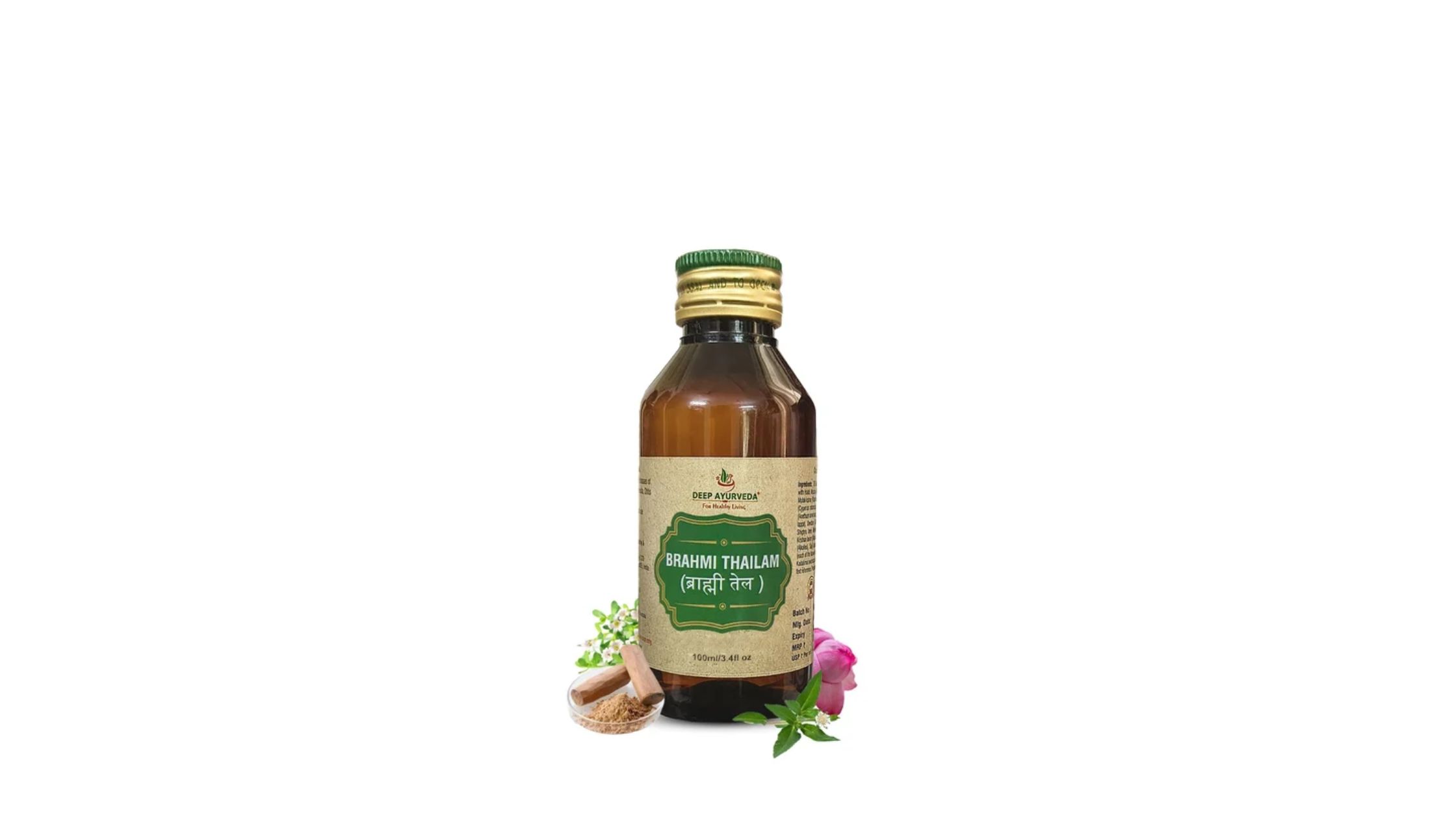
For generations, oiling the head has been a familiar part of Indian self-care. In Ayurveda, however, applying oil to the head is more than a simple hair-care habit. The traditional practice of Shiro Abhyanga gives head massage a broader place within daily Ayurvedic routines.
Brahmi Thailam is one of the herbal oil preparations associated with this tradition. It is commonly used for scalp and hair care and is also traditionally selected for head massage and relaxation. But there is an important detail that is often missed in modern articles: Brahmi Thailam is not necessarily one identical formula.
The ingredients, preparation methods, base oils, and intended uses can differ between formulations. Even the word Brahmi can create confusion because different plants may be associated with this name in different Ayurvedic and regional contexts.
So, rather than treating Brahmi Thailam simply as another hair oil, it is worth understanding the tradition behind it—what Thailam means, why these oils are traditionally applied to the head, how formulations are prepared, what ingredients may be present, and how to use them thoughtfully.
What Is Brahmi Thailam?
Brahmi Thailam is a traditionally prepared Ayurvedic herbal oil intended primarily for external application, particularly around the head and scalp.
The word Thailam or Taila refers broadly to an oil preparation in Ayurveda, while Brahmi indicates the principal herb or herbal identity associated with a particular formulation.
Unlike a simple cosmetic oil made by blending an herb with a carrier oil, a traditional Ayurvedic medicated oil may involve a specific processing method in which herbs and other ingredients are prepared and processed with an oil base.
This distinction matters because two products carrying the name Brahmi Thailam may not have exactly the same composition.
Depending on the formulation, you may find ingredients such as:
Therefore, the product label—not just the name Brahmi Thailam—should always be checked to understand what a particular preparation actually contains.
In simple terms
Brahmi Thailam is an Ayurvedic herbal oil traditionally used for head and scalp application, with its exact composition depending on the formulation.
This makes it different from treating Brahmi Thailam as though it were a single standardized commercial recipe.
Why Is Brahmi Thailam Traditionally Associated With the Head?
One of the most interesting ways to understand Brahmi Thailam is through the Ayurvedic practice of Shiro Abhyanga, or oil massage of the head.
In traditional Ayurveda, oil application and massage have long been incorporated into personal-care routines. The head is given particular attention, and gentle oil massage is traditionally used as a calming and nourishing practice.
Brahmi Thailam fits naturally into this tradition because its application is generally centered around the scalp and head rather than being used simply as a body moisturizer.
Understanding Shiro Abhyanga
Shiro refers to the head, while Abhyanga refers to the traditional practice of oil massage.
A typical head-oiling routine involves applying a suitable oil to the scalp and gently massaging it with the fingertips. The emphasis is not on forceful rubbing but on comfortable, controlled movements.
This traditional approach also explains why Brahmi Thailam is often discussed in relation to:
- scalp care
- hair oiling
- head massage
- relaxation
- bedtime self-care routines
It is important, however, not to confuse traditional use with a guarantee of treating a medical condition.
What Makes Brahmi Thailam Different From Regular Hair Oil?
At first glance, Brahmi Thailam may look like any other hair oil. The difference lies mainly in how the formulation is conceived and prepared.
A regular hair oil may primarily function as a cosmetic product designed to lubricate the hair, reduce dryness, improve manageability, or add shine.
An Ayurvedic Thailam, on the other hand, is traditionally understood as a herbal oil preparation in which selected botanical ingredients are processed with an oil base.
| Regular Hair Oil | Brahmi Thailam |
|---|---|
| Often designed primarily for cosmetic hair care | Traditionally formulated as an Ayurvedic herbal oil |
| May contain a simple blend of oils | May contain multiple herbs processed with an oil base |
| Focus may be hair conditioning | Traditionally associated with head, scalp and hair-care routines |
| Composition varies by product | Composition can vary considerably by formulation |
| May simply blend ingredients | Traditional preparations may involve specific oil-processing methods |
This does not mean that every Brahmi Thailam is automatically superior to every regular hair oil. It simply means they should not be considered identical categories.
The formulation and intended use matter more than the name printed on the bottle.
What Ingredients Are Found in Brahmi Thailam?
There is no single ingredient list that applies to every product sold as Brahmi Thailam.
Different manufacturers and formulations may use different herbs, proportions, oil bases, and preparation methods. This is why understanding the role of individual ingredients can be more useful than memorizing a single standard formula.
Brahmi
Brahmi is the defining botanical name associated with this category of formulations. In Ayurvedic and commercial contexts, however, the term can sometimes refer to different plants.
This is one reason consumers should check the botanical name on the product label instead of relying only on the common name.
Sesame Oil
Sesame oil, traditionally known as Tila Taila, is a common oil base in Ayurvedic preparations.
It provides the lipid medium in which herbal ingredients can be processed and is also widely used in traditional Ayurvedic oiling practices.
Amalaki
Amalaki, commonly known as Indian gooseberry, is another botanical frequently encountered in Ayurvedic hair and scalp formulations.
In traditional Ayurvedic practice, Amalaki is valued as a Rasayana-associated herb and is also widely used in traditional hair-care preparations.
Bhringraj
Bhringraj is another well-known Ayurvedic herb frequently found in traditional hair-oil formulations.
However, its presence should not be assumed in every Brahmi Thailam. Always check the individual product’s ingredient list.
Yashtimadhu and Other Herbs
Some formulations may include Yashtimadhu and other herbs selected according to the intended formulation.
This variation is not necessarily a problem. In fact, it is an important characteristic of Ayurvedic formulation practice: the name of a product does not always tell you the entire composition.
Is Every Brahmi Thailam Made With the Same Ingredients?
No.
This is one of the most important things to understand before purchasing or using Brahmi Thailam.
Different products available in India can have substantially different formulations. One may use Brahmi with sesame oil, while another may combine Brahmi with Amalaki, Bhringraj, Yashtimadhu, sandalwood or other botanicals.
This means that statements such as Brahmi Thailam always contains these five ingredients can be misleading.
A better approach is to ask:
What exactly is in this particular Brahmi Thailam?
Before choosing a product, look for:
- Complete ingredient disclosure
- Botanical names where available
- The base oil used
- Directions for external use
- Manufacturer information
- Batch and manufacturing details
- Appropriate precautions
- A clearly stated intended use
A useful rule for consumers
Do not choose Brahmi Thailam only because the front label says Brahmi. Read the full ingredient list.
That one habit can tell you much more about a product than the product name alone.
Brahmi or Mandukaparni? Understanding the Naming Confusion
The word Brahmi deserves special attention because it is not always used consistently across products and sources.
Bacopa monnieri is widely known as Brahmi, while Centella asiatica is also associated with the name Brahmi in certain Ayurvedic and regional contexts and is commonly known as Mandukaparni.
This creates an important practical point:
The common name alone may not be enough to identify the botanical used in a product.
If you want to know which plant a particular Brahmi Thailam contains, look for its botanical name in the ingredient list or product information.
This distinction is particularly useful when comparing two products that both use Brahmi prominently on their packaging.
Why does this matter?
Different plants have different botanical identities, constituents and traditional Ayurvedic descriptions.
So, when comparing Brahmi-based products, compare the actual formulation, not just the product name.
How Is Brahmi Thailam Traditionally Prepared?
Traditional Ayurvedic medicated oils are not necessarily produced by simply mixing herbs into oil.
A classical oil-preparation approach may involve a process broadly referred to as Sneha Paka, in which the oil is processed with selected herbal materials and an appropriate liquid component according to the formulation.
Three terms help explain the basic concept:
Kalka
Kalka refers to the herbal paste used during the preparation.
Drava
Drava refers to the liquid component used in the formulation. Depending on the preparation, this may involve a decoction, herbal juice, or another specified liquid medium.
Sneha
Sneha refers to the fatty medium, commonly oil or ghee, used as the base.
The purpose of controlled processing is not simply to mix ingredients but to prepare the medicated oil according to the requirements of the particular formulation.
Why this matters to the consumer
When you see the word Thailam, it can indicate a formulation concept that is more specific than oil containing herbs.
However, modern commercial products can vary in how closely their formulation follows a classical reference, and some are proprietary formulations.
That is why it is useful to distinguish between:
classical formulation, proprietary Ayurvedic formulation, and ordinary herbal/cosmetic oil.
Traditional Benefits of Brahmi Thailam
Brahmi Thailam is traditionally associated with several aspects of head and hair care. However, the exact traditional use depends on the formulation.
Rather than presenting every possible claim as a medically proven benefit, it is more accurate to understand its uses in context.
1. Hair and Scalp Care
Oil application can help lubricate the hair and scalp and may form part of a regular hair-care routine.
The conditioning effect of oil can be particularly useful when hair feels dry or rough.
However, hair conditioning is not the same thing as treating the underlying cause of hair loss.
2. Head Massage
Brahmi Thailam is commonly used for head massage as part of an Ayurvedic self-care routine.
Gentle massage combined with oil application can make the practice feel relaxing and soothing.
3. Relaxation
Traditional Ayurvedic routines often emphasize regularity and calmness rather than simply applying a product when a problem appears.
For this reason, head oiling may be incorporated into an evening self-care ritual.
4. Traditional Sleep-Related Use
Some Brahmi Thailam formulations are traditionally associated with nighttime head application and relaxation.
However, this should not be interpreted as proof that the oil can diagnose or treat insomnia or another sleep disorder.
If sleep problems are persistent, frequent or significantly affecting daily life, addressing the underlying cause is more important than relying on an external oil alone.
Brahmi Thailam for Hair and Scalp: What Can You Expect?
This is where realistic expectations matter.
People often search for Brahmi Thailam because they want help with hair fall, dryness, dandruff or overall scalp health.
Oil can certainly be part of a sensible hair-care routine, but not all hair problems have the same cause.
For example, there is a difference between:
- dry, rough hair
- hair breakage
- temporary increased shedding
- persistent hair loss
- scalp inflammation
- dandruff
- hereditary hair thinning
An oil may help condition the hair and make the scalp-care routine more comfortable, but that does not mean it will correct every underlying cause of hair loss.
Hair fall is not always a hair-oil problem
Persistent or sudden hair shedding can have many possible causes, including nutritional issues, hormonal changes, stress, illness, medications and hereditary factors.
Therefore, Brahmi Thailam can be viewed as part of supportive hair and scalp care, rather than as a universal solution for hair loss.
This distinction is important because it keeps expectations realistic.
How to Use Brahmi Thailam
The exact directions should always follow the product label because formulations can differ.
For a traditional scalp-oiling routine, the general approach is straightforward.
Step 1: Prepare the oil
Take an appropriate quantity of oil according to the length and density of your hair and the product’s instructions.
If warming is recommended for the particular product, use gentle warming rather than making the oil excessively hot.
Step 2: Apply to the scalp
Part the hair into sections and apply the oil directly to the scalp.
Use the fingertips rather than the fingernails.
Step 3: Massage gently
Massage the scalp using slow, comfortable circular movements.
There is no need to press aggressively.
A good scalp massage should feel comfortable, not painful.
Step 4: Allow the oil to remain
How long you should leave the oil on depends on your routine and the specific product instructions.
Some people prefer applying oil before a hair wash, while others incorporate head oiling into an evening routine.
Step 5: Wash the hair if required
Use a suitable cleanser to remove excess oil without aggressively scrubbing the scalp.
When Should You Apply Brahmi Thailam?
There is no single universally best time for everyone.
Before hair washing
This can be convenient if you prefer to oil the scalp before cleansing.
In the evening
Some people prefer evening head massage because it fits naturally into a slower self-care routine.
Before bedtime
If the formulation and personal routine permit it, some people choose nighttime application.
However, leaving oil overnight is not automatically better for everyone.
A person with an oily scalp may prefer a shorter application period, while someone with dry hair may prefer more prolonged oiling.
Your scalp type, routine and the product’s instructions should guide the frequency and duration.
Can You Use Brahmi Thailam Every Day?
Daily use is not automatically necessary.
The appropriate frequency depends on:
- scalp type
- hair texture
- amount of oil used
- formulation
- climate
- personal preference
- how the scalp responds
For some people, regular but less frequent oiling may be more practical than daily application.
If your scalp becomes itchy, irritated, unusually greasy or uncomfortable after application, reduce use and reassess the product.
Brahmi Thailam vs Other Ayurvedic Hair Oils
Not every Ayurvedic oil is designed around the same formulation concept.
Brahmi Thailam vs Bhringraj Oil
Both may appear in traditional hair-care routines, but their formulations and primary herbal identities differ.
Brahmi Thailam vs Neelibhringadi Thailam
Neelibhringadi Thailam is a different Ayurvedic formulation with its own combination of herbs and traditional indications.
It should not be treated as simply another name for Brahmi Thailam.
Brahmi Thailam vs Coconut Oil
Coconut oil is primarily a carrier/cosmetic oil commonly used for hair conditioning.
Brahmi Thailam, depending on its formulation, may contain several botanicals processed into an oil base.
Brahmi Thailam vs Amla Oil
Amla oil emphasizes Amalaki as a major ingredient or traditional identity, while Brahmi Thailam is centered around its Brahmi-associated formulation.
The better oil therefore depends on what you are trying to include in your hair-care routine, rather than one product being universally superior.
Who Should Take Extra Care Before Using Brahmi Thailam?
Although external herbal oils are commonly used, they are not automatically suitable for everyone.
Take additional care if you:
- Have a known allergy to any listed ingredient
- Have cuts, wounds or active irritation on the scalp
- Experience burning or significant itching after application
- Have a diagnosed scalp condition
- Are considering use in a young child
- Are pregnant or breastfeeding and have concerns about specific herbal ingredients
- Are using other topical scalp treatments
Perform a patch test when appropriate, follow the manufacturer’s directions, and discontinue use if significant irritation develops.
For persistent scalp symptoms or unexplained hair loss, professional evaluation is more appropriate than continuously changing hair oils.
How to Choose a Good Brahmi Thailam
Choosing an Ayurvedic oil should involve more than looking for the word natural on the packaging.
1. Check the complete ingredient list
A transparent label makes it easier to understand what you are actually buying.
2. Look for botanical names
This is especially important when common names such as Brahmi can refer to different plants in different contexts.
3. Understand the base oil
Sesame oil is common in Ayurvedic preparations, but other products may use different bases.
4. Understand the intended use
Is the product intended for scalp massage, hair care, general external use, or a particular traditional purpose?
5. Avoid exaggerated promises
Be cautious of products or articles claiming that one oil can cure every form of hair loss, anxiety, insomnia or neurological disease.
Traditional Ayurvedic use and guaranteed medical treatment are not the same thing.
6. Prefer formulation transparency
The more clearly a manufacturer explains its ingredients, directions and product identity, the easier it is for consumers to make an informed decision.
Traditional Ayurveda vs Modern Evidence: What Should You Actually Believe?
This is an important distinction when reading about any Ayurvedic product online.
Ayurvedic texts and traditional practice provide a framework for understanding herbs, oils, massage and formulations. Modern scientific research, meanwhile, investigates individual herbs, compounds, preparations and health outcomes using different methods.
These two forms of knowledge should not automatically be treated as interchangeable.
For example:
Research on Brahmi as an individual herb does not automatically prove that every commercially available Brahmi Thailam will produce the same result.
Why?
Because the finished oil may differ in:
- plant species
- extraction or processing method
- concentration
- additional herbs
- base oil
- manufacturing process
- intended route of use
Therefore, a responsible article should distinguish between traditional Ayurvedic use, evidence relating to individual ingredients, and evidence specifically relating to a finished Brahmi Thailam formulation.
That distinction is often missing from generic online content—and it is one of the most important things a reader should understand.
Final Takeaway
Brahmi Thailam is best understood not simply as another hair oil, but as part of the broader Ayurvedic tradition of herbal oil preparation and head oiling.
Its appeal lies in the combination of traditional formulation, herbal ingredients and the practice of Shiro Abhyanga. At the same time, there is no single universal Brahmi Thailam formula. Products can differ in their herbs, base oils, preparation methods and intended uses.
Frequently Asked Questions About Brahmi Thailam
What is Brahmi Thailam used for?
Brahmi Thailam is traditionally used as an external Ayurvedic oil, particularly for head and scalp application, hair-care routines and Shiro Abhyanga.
Is Brahmi Thailam good for hair?
It can be used as part of a hair and scalp-care routine, particularly for oiling and conditioning. However, it should not be considered a guaranteed treatment for hair loss.
Does Brahmi Thailam stop hair fall?
There is no basis for claiming that every Brahmi Thailam can stop hair fall because hair loss has many different causes. Traditional oiling may support general hair and scalp care, while persistent hair loss should be evaluated according to its underlying cause.
Can Brahmi Thailam be used every day?
Daily use is not necessary for everyone. Follow the product directions and consider your scalp type, hair condition and how your scalp responds.
Can Brahmi Thailam be left overnight?
Some people use hair oils overnight, but this is not essential for everyone. Follow the product instructions and avoid overnight use if it causes scalp irritation or excessive oiliness.
Is Brahmi Thailam the same as Brahmi oil?
Not necessarily. Brahmi oil can be used as a broad commercial description, while Brahmi Thailam may refer to a more specific Ayurvedic oil formulation. Always compare the actual ingredient list.
What is the difference between Brahmi and Mandukaparni?
Brahmi is commonly associated with Bacopa monnieri, while Centella asiatica is known as Mandukaparni and may also be called Brahmi in some contexts. Checking the botanical name is the best way to identify the plant used in a product.
Is Brahmi Thailam safe?
Safety depends on the formulation, ingredients and individual sensitivity. Use it externally according to the manufacturer’s directions and stop if significant irritation occurs.


